◆
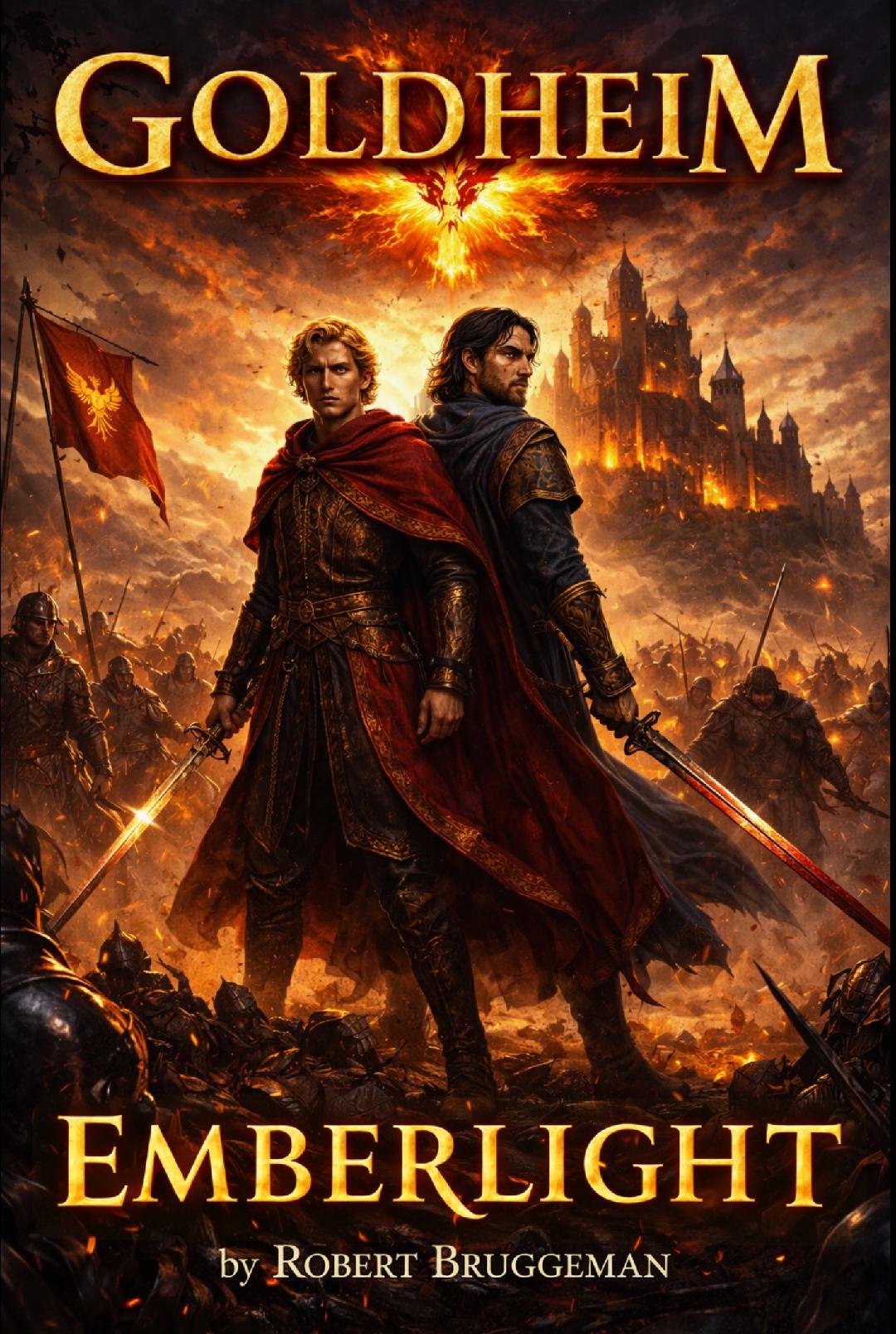
Goldheim: Emberlight
Chapter One
✦Dawn broke over the city of Embercrest, the rising sun painting the towers of the capital in fire and rose. The capital was named in dedication to the Phoenix whom the citizens of Goldheim worship as divine. The city was only just stirring as bakers lit their ovens, the guards changed watch at the gates and the bells of the cathedral tolled the hour. The stillness of the morning was shattered by the thunder of hooves. A lone rider tore down the King’s Road, cloak whipping behind him, his horse lathered with sweat and foam. A cloud of dust billowed in his wake, but he did not slow. The guards at the gate exchanged startled glances as the rider’s horn rang sharp and urgently.
“Open! Urgent news for the Queen!” he cried, his voice hoarse from the ride.
The giant gates creaked open and the messenger surged through, spurring his mount across the cobblestones. As he galloped through the winding streets, his hurried race startled the merchants setting up their stalls and sending children scrambling as they darted aside. Despite the danger, he did not slow. The message he carried outweighed the risk. Lives depended on it.
High above the courtyard, Queen Elinor Valemont stood unaware of the riders’ desperate flight. She lifted her face to the sun’s rays, enjoying the warm peace of dawn. She had ascended to the throne two years earlier after the untimely demise of her husband. While her ascent was not initially welcomed by all in the kingdom, the years since had been prosperous and relatively peaceful. For a country whose neighbors ranged from indifferent to downright hostile, her reign so far had proven a welcome respite for Goldheim’s war-weary citizens.
Dressed not in her royal regalia but in a simple gown of deep blue velvet, she had expected a day of quiet council rather than grand ceremony. Behind her, a crib rested near the hearth. Within slept her grandson, Rockland, heir to two great kingdoms. His tiny chest rose and fell with steady breaths, his small hands wrapped around his favorite toy horse. The same toy was once his father’s, the memory of which brought a small smile to her lips.
It was in this moment of peace that the sound of approaching boots echoed down the outer corridor beyond the doors. The sound of knuckles hurriedly rapping drew her attention, the
◆
calmness of the morning instantly shattered. The maid hastened to open the door and led the unexpected visitor directly into the queen’s solar. The rider stumbled inside, covered in dust and sweat, bowed quickly before the queen and held out a sealed scroll.
“My lady,” he gasped, “I bring word from the northwest. Raiders have attacked the borderlands. Villages burn. If aid is not sent swiftly, the land and your people will be lost.”
The Queen’s eyes sharpened like drawn steel as her hand left the windowsill and curled into a fist at her side. After she read the message, she did not immediately speak. Instead, she turned her gaze to the cradle where her grandson slept, his innocent dreams untouched by the shadow that had just been cast over the realm. Her brief pause was quickly replaced with action. She ordered the council to be summoned. The chamberlain bowed low and left to carry the urgent summons. Moments later a distant bell rang, its deep iron toll echoing through the corridors of the Golden Keep. One by one, councilors and lords emerged from their quarters, their footsteps soon filling the marble floored corridors as they hurried towards the council chamber.
Once all were gathered, Prince Ambrose entered, his golden hair catching the dawn light that filtered through the tall stained- glass windows. Though still young in the eyes of some of the councilors, his bearing was proud, a quiet strength tempered by the weight of recent fatherhood. His eyes flickered briefly toward the absent seat at his side. His husband, Prince Amaranth, would have occupied that chair had fate not called him back home to Eisenmark. Ambrose felt his absence keenly. Days earlier, a raven had arrived bearing the grim tidings. Amaranth’s father, the King of Eisenmark, had collapsed with a sudden illness. Amaranth had ridden out at once, a husband torn from his family by duty, leaving Ambrose to guard both their son and their shared realm.
Now Ambrose stood alone before his mother and her council, the heavy mantle of leadership pressing upon him in his husband’s absence. The Queen, seated high upon her gilded throne, gestured to the hall for silence. Her sharp eyes swept the gathered lords and captains before settling on her son. “A message has come from the north,” she said, her voice like a blade cutting through the hall. “Not just raiders this time, but
◆
rumors of monstrous beasts and dark beings as well. Whispers of foul sorcery ride with them. Villagers speak of strange disappearances in the night, of murdered bodies found tied to trees, their dead eyes wide with terror. If this is true, then shadows have fallen upon our borders, and they creep closer with every hour.”
The lords in the chamber shifted uneasily, their faces pale. Murmurs ran like a current through those gathered, half disbelieving and half afraid. Some spoke of beasts that had not been seen since the old wars with Drachenwald. Others whispered of sorcerers whose names were long thought gone, buried in forgotten tomes.
Blocking out the furor and panic, Ambrose drew a steadying breath. His hand brushed the phoenix pendant at his chest, a reminder of the vow he had spoken with Amaranth: Together, Always. Though parted by distance, his husband’s strength was with him still. He stepped forward, his voice clear, and declared.
“If monsters prowl our lands and dark magic has returned, we will not sit idle. The people of Goldheim must know that their Crown will defend them. Whatever lurks in the shadows, we will meet with light and with steel.”
At once the council chamber erupted, voices rising in objection or heated debate. Yet at the heart of the storm, Ambrose stood unshaken. His mother watched with a quiet gleam of pride coupled with a flicker of concern for the darkness that even she did not yet understand. As the noise continued to escalate, she raised her hand for silence after which the hall hurriedly fell into order. No one dared disrespect the queen. For a moment the chamber was hushed. Then, like sparks in dry grass, the storm of voices began again.
“My prince,” barked Lord Halvar of Northgate, slamming his fist upon the table, “we cannot march on shadows and superstitions! Tales of beasts and sorcery are meant to frighten children. More likely, it is bandits stoking fear to keep our soldiers away. I say we wait until more evidence reaches us.”
Lady Brenna of Cape Wyndriche rose to her feet, her fur-lined cloak sweeping behind. Her dark eyes burned as she spoke. “Tell that to the families who find their kin strung up in trees like slaughtered animals! If we do not ride now, those horrors will be at our very gates. You call them bandits, I call them a scourge.”
◆
Murmurs rippled, some nodding grimly, others shaking their heads. Lord Caedmon, a gaunt man whose lands bordered the western woods, leaned forward, his voice low but trembling. “My men found three of my village folk... tied upright to the oaks. Their flesh…” He faltered, swallowing hard. “It was not wolves, nor any blade I know. The wounds were blackened, as if the very life had been sucked from them. If that is no sorcery, then I know not what is.”
A younger knight scoffed, his face flushed with bravado. “Old wives’ tales! Every generation hears whispers of dark magic. I say we keep our steel at the ready but do not waste strength chasing phantoms.”
The Queen raised her hand for silence, but this time the chamber would not be contained. Voices rose from every side of the council table, overlapping until argument swallowed order.
“Gather the armies now!” Lord Roxbury demanded. “Every hour we delay gives these creatures another village.”
“And leave Embercrest undefended?” another lord shot back. “We do not even know what we face. If this is the beginning of a larger assault, stripping the capital of its defenses is precisely what our enemy would want.”
Lady Brenna leaned forward. “Then we do both. Call the levies and send the standing companies ahead. We need not empty the walls to defend the countryside.”
“With respect, my lady, you speak as though we know where to send them,” Chancellor Durn countered. “We have frightened villagers, burned farms, and tales of beasts in the dark. That is not intelligence upon which one marches an army.”
“Tell that to the families burying their dead,” someone snapped.
“And while they ride in circles, how many more villages burn?”
The Queen tried again to intervene, but the arguments only multiplied.
“Fortify the capital!” “Call the western banners!” “Seal the mountain roads!” The chamber teetered on the edge of chaos. Then Ambrose stepped forward. “Enough!”
◆
The word cracked through the hall like thunder. Silence fell and every eye turned toward the prince. Ambrose stood tall before them, one hand resting upon the phoenix pendant at his chest. When he spoke again, his voice was quieter, but no less commanding.
“Doubt if you must. Argue if you will. Caution has its place, and I will not condemn any man here for wishing to protect his people.” His gaze moved deliberately around the table. “But while we debate what name to give this enemy, our people are dying.”
No one interrupted him. “This council cannot be ruled by fear, nor lulled by denial. Whether we face beast, sorcery, bandit, or something we have yet to understand matters little to the dead.” His fingers tightened around the pendant. “What matters is this. We will not abandon those who look to us for protection.”
Ambrose swept his gaze across the assembled lords. “I will lead our forces. We will leave enough men to defend Embercrest, and scouts will ride ahead of the main army. We will learn what we face. But we will learn it while moving toward our people, not while hiding behind these walls.”
The council chamber seemed to hold its breath. The Queen studied her son in silence, her keen gaze searching his face as though weighing not merely his words, but the man who had spoken them. For several heartbeats, no one moved.
Then Lady Brenna gave a firm nod, her hand resting upon the hilt of her blade.
“You have my sword, Your Highness.” Across the table, Lord Halvar frowned. “I still say we risk moving too quickly.”
“And I say we risk far more by doing nothing,” another lord replied.
Halvar glanced toward him, then back to Ambrose. His expression remained troubled, but some of the resistance had gone from it.
A chair scraped against the stone floor. Lord Dieter rose. The room quieted at once. As commander of Goldheim’s armies, Dieter had remained silent through much of the debate, listening while nobles shouted
◆
over one another. Now he stood straight and stern at the Queen’s table, every eye upon him.
“We can reinforce Embercrest before the main host departs,” he said. “The city garrison remains. Two companies stay behind, along with the palace guard. The rest can be ready to march by first light.”
He looked directly at Ambrose. “The prince is right about one thing. Whatever waits beyond these walls will not become less dangerous because we give it another day.”
Then Dieter turned to the Queen and bowed his head. “My Queen, I support the prince.” That carried weight. One by one, others began to follow. “My riders will join the vanguard.” “I will send word to my bannermen tonight.” Even some who had argued for caution began to concede, reassured by Dieter’s promise that Embercrest would not be left defenseless. At last, all eyes came to Lord Halvar. For a moment he remained stubbornly still. Then he released a long breath.
“I still believe this course carries grave risk.” Ambrose met his gaze. “It does.” Something in the answer seemed to surprise him. Halvar studied the prince for another moment before slowly bowing his head.
“Then let us pray we are equal to it.” The Queen watched them all. Only when the chamber had fallen completely silent did she rise. The scrape of her chair against the stone seemed unnaturally loud. She looked first to Dieter, then to the assembled lords, and finally to her son. When she spoke, her voice carried the weight of iron.
“Then so it shall be.” Her gaze settled upon Ambrose. “Goldheim rides at dawn.”
◆
The Eisenmark Captain
The sun had barely touched the horizon when Aurelgate, “The Golden Keep,” stirred to life. In the courtyard, smiths hammered iron blades, grooms led horses from the stables and soldiers buckled on their mail. Prince Ambrose stood in his chamber, fastening the last clasps of his armor. He paused for a moment, glancing toward the crib where Rockland still slept peacefully. A pang of longing struck him, but he pressed it down. Duty called. A knock came at the door.
“Enter,” Ambrose called, his voice calm and steady. The door swung open. Lord Mark Stratham stepped through, the familiar sight of his oldest friend bringing unexpected warmth to the room. They had grown up, side by side, within the walls of Aurelgate, sharing tutors, sparring yards, hunts, triumphs, and hardships until the kingdom itself had come to think of them as nearly inseparable. Even now, after years of war and duty, Mark remained Ambrose’s closest confidant and constant companion. The seasoned lord inclined his head respectfully before stepping aside.
“I’ve brought someone to see you, Your Highness.” Behind him entered a tall knight clad in Eisenmark’s steel- grey plate. His cloak bore the proud silver stag of House Eisenmark, and the respect in his eyes was unmistakable. He dropped gracefully to one knee.
“My prince,” he said, bowing his head. “I am Captain Erich of Eisenmark. His Highness, your husband, commanded me to remain here with a battalion of our knights to guard you and your son in his stead. But word has reached us of your march.”
Ambrose nodded. “It is true. Darkness creeps over our borders. I cannot wait for Amaranth to return.”
Captain Erich stepped forward, his voice firm. “Then know this. Where you ride, we ride. Prince Amaranth gave us one command above all others—to protect his family with our lives.
◆
That means you, my lord. My men are yours as much as his and we will not let you march into peril without us.”
Ambrose’s throat tightened. For a moment, he saw Amaranth’s hand in this—his foresight, his unwavering devotion. Even though parted by leagues, his husband’s love was a shield around him. He placed a hand on the captain’s shoulder.
“Then I welcome you, Captain Erich. Together, Goldheim and Eisenmark will stand side by side. We will show this darkness that the bonds of our crowns are stronger than fear.”
Outside, the horns began to sound, calling soldiers to form ranks. Ambrose cast one last look at the cradle, then turned and strode toward the courtyard, the captain falling into step at his side. The courtyard thundered with the sound of armored boots and stamping hooves. Among the forces, Goldheim’s phoenix banners rippled beside Eisenmark’s stag, the two emblems fluttering together in the cool morning air. Hundreds of soldiers stood in ordered ranks, spears glinting, shields polished, the smell of oiled leather and steel thick in the air. Ambrose stood at the fore, his hand resting on the reins of his great warhorse, the animal tossing its head as though eager for the road ahead. He was about to mount when a sudden hush fell across the gathered soldiers.
From the shadow of the keep’s gates, the Queen emerged. Her presence commanded silence as surely as a trumpet’s call. Draped in a mantle of deep red trimmed with silver, her crown gleamed in the sun’s light. Though age had lined her face, her eyes shone with the fire of a ruler whose will had never bent. Guards flanked her, but it was clear she needed no escort.
She strode to the front of the troops, standing tall before the gathered soldiers.
For a moment, she said nothing, letting the silence stretch. Then her voice rang out, strong and carrying over the courtyard. “Warriors of Goldheim! Knights of Eisenmark! Today you ride not for plunder, nor for glory, but for the lives of the innocent. Dark tidings creep from the northwest. Monstrous things that would unmake our peace, which would tear children from their mother’s arms. Things that would stain our homes with terror. But hear me well!” Her voice rose, sharp and commanding. “They will not find fear in Goldheim. They will not find weakness here. They will find a people united. They will find sons and
◆
daughters who stand together, who would rather die with honor than live in chains of dread. And when they look upon you, let them see the steel of your swords and the fire of your courage. Let them see the light of the phoenix and the strength of the stag. Let them despair!”
The gathered soldiers erupted in thunderous cheers, spears pounding shields in unison. Even the warhorses reared and snorted, caught up in the fire of her words. Ambrose felt his heart swell as he looked upon his mother—queen, leader and the indomitable soul of Goldheim.
The Queen turned to him at last, her voice lowering so only he could hear. “Ride well, my son. Show them what it means to be born of crown and fire. And remember, you are never truly alone.”
Ambrose bowed his head, pressing his hand over his heart. Then, with one smooth motion, he mounted his warhorse.
The gates of Aurelgate swung wide with a deep groan of iron and oak. Beyond, the great avenue stretched through the city’s heart, lined with soaring statues of kings and queens long passed. The morning sun poured golden light upon the cobblestones as the combined host began its march. Ambrose rode at the front, his armor gleaming and crimson cloak flowing behind him, the phoenix of Goldheim emblazoned upon his chest. On his left side rode Captain Erich, the stag banner unfurled in the breeze, its silver thread catching the light. On his right rode Mark, his rock of support. Behind them stretched row upon row of soldiers, their boots pounding in unison, their spears rising like a forest of steel.
The people poured into the streets to meet them. Merchants left their stalls, mothers held up children to see, old men leaned on canes with prideful memories in their eyes. The crowd pressed close, filling balconies and leaning from windows, showering the riders with cheers.
“Long live the Prince!” “Defend us, Ambrose!” “Bring light against the darkness!” Flowers were cast into the path of the march, petals scattering beneath the hooves of the warhorses. Some reached out to touch the stirrup of a passing knight, others lifted their
◆
arms skyward. The sound of cheers grew into a mighty roar, echoing against the stone walls and towers of the capital.
Ambrose raised his hand, acknowledging the people, his heart swelling. He thought of Amaranth far away in Eisenmark, of Rockland sleeping safely in the cradle and of the vow that bound them together. Though the shadows whispered from the northwest, though dark magic threatened the borders of the realm, he felt in that moment the unshakable strength of his people.
The army passed beneath the city gates, banners snapping in the wind. Ahead lay the road north, into lands of dread and mystery. Behind them, the city of Embercrest stood united, its faith carried on the voices of its people. The march into darkness had begun.
◆
Eisenmark
Far to the west in Crownstag, the capital of Eisenmark, the air carried the sharp scent of pine and cold stone. The great hall was quiet, its banners unmoving, for much of the court lingered in hushed vigil in honor of the king. Within the king’s chamber, the room was warm with braziers and the scent of bitter herbs. The King lay upon his bed, his once mighty frame thinned by the illness that had struck him down. His beard, streaked with iron and grey, spilled across his chest and his eyes flashed beneath heavy brows as he regarded his son.
Amaranth stood at his bedside, his dark hair falling about his shoulders, his posture steady but respectful. He wore no armor, only a simple tunic of deep green, though the calluses of his sword hand could not be hidden. The physicians had said the king’s ailment was of the heart. He was healing now, yet the recovery made him irritable for he was a man accustomed to command not confinement. His voice, though weaker than it once had been, still carried the timbre of thunder. “You came swiftly,” the king said, his tone half grudging. “At least you’ve sense enough to know when your father’s life outweighs your play- acting in Goldheim.”
Amaranth’s jaw tightened, but he bowed his head. “I came because you are my father.
“Nothing is more important than your health.” “Hmph,” the king snorted, shifting restlessly in the bed. “Fine words. But what use is sentiment? Your brothers see to matters of state. Your eldest, Rodrik, manages the treasury.
“Gerron commands the northern passes. And you.” His eyes narrowed. “You spend your days at the side of a foreign prince, playing nursemaid to a crown not your own.”
Amaranth lifted his gaze, calm but steady. “Ambrose is not just a prince. He is my husband.
“My equal. Together, we stand stronger than apart.”
◆
The king barked a laugh that quickly dissolved into a cough. “Stronger? Bah! Strength comes from a man standing on his own legs, not leaning on another’s shoulder. You think love makes you strong? Love makes you weak, boy. It makes you soft.”
For a moment, silence filled the chamber, broken only by the crackle of the fire. Amaranth let the words settle, as he had so many times before in his father’s presence. Then he spoke, quiet but unyielding. “Perhaps you’re right. Perhaps I am softer than you. But if kindness is weakness, then I will bear it proudly. My people love me for it, even if you do not. And Ambrose, he has given me something no crown ever could. A reason worth fighting for.”
The king’s eyes flickered, just for an instant. A shadow of something, doubt perhaps or even respect, before the stern mask returned. He turned his face away, staring into the rafters. “You sound like your mother,” he muttered, almost to himself. “And she too was too soft for this world.”
Amaranth stood a long while, watching his father in silence, knowing the words were not meant for him alone. The mountain winds howled faintly against the shutters and in that lonely chamber, son and father stood divided by more than a sickbed. A lifetime of conflicting ideals neither could bend, existed between them. With a sigh, he took a calming breath, turned and left. He shut the heavy door behind him with a muted thud, but the echo of his father’s words followed him like a curse. His steps were sharp on the stone floor, hands clenched, jaw tight. He had learned long ago not to let his father see him bleed, but outside of that the chamber, where the weight of his gaze could no longer reach, the wound always broke open.
“Another audience with our illustrious sire?” The voice drifted from the shadows. Amaranth looked up to see Rodrik leaning against a carved pillar, arms folded, a crooked smile playing at his lips. The eldest son always had a way of appearing when Amaranth most needed him, as if he could scent his younger brother’s turmoil.
“You make it sound like jest,” Amaranth muttered, running a hand through his dark hair. “You know what he’s like.”
Rodrik pushed off the pillar and came closer, boots echoing in the corridor. “I don’t need to imagine. I’ve worn that same
◆
expression countless times leaving that room. He never changes.”
Amaranth gave a bitter laugh. “He never will. I don’t know why I keep hoping he might.” “Because you’re you,” Rodrik said, his voice softening. “You want to see the good in him, even when it’s buried so deep it may never be found.”
They walked together, their steps slow beneath the flicker of torchlight. Rodrik glanced sidelong at him then added, “He’s hardest on you, Amaranth. You know that.”
Amaranth stopped, his throat tightening. “I know.” Rodrik hesitated, then went on, “I think it’s because you look like her. Our mother. The curve of your cheek, your eyes when you smile. He sees her ghost every time he looks at you and it stirs something in him he cannot master. Anger. Guilt. Maybe even... love. Though he’s long forgotten how to show it.”
Amaranth swallowed hard. He had suspected it, but hearing it spoken aloud made it burn deeper. “So, because I remind him of her, he despises me?”
Rodrik shook his head. “Not despise. You cut him more deeply than the rest of us. With me, he sees a soldier, someone who could be molded in his own image. With Gerron, he sees a scholar, a mind that could serve his ambitions. But with you... he sees what he has lost, and it terrifies him. Instead of cherishing you, he lashes out. That’s his failing, not yours.”
Amaranth gave a bitter half smile. “And yet, I carry the lash of it.”
“You carry more than that,” Rodrik countered firmly. He gripped his brother’s shoulder, eyes steady. “You carry the people’s love. You carry a heart that hasn’t been hardened into iron like his. Do you know how rare that is? How many would kill for what you have? You think the soldiers follow me because I’m firstborn? No. They follow you. Because you make them feel seen, valued. That’s power Father will never understand.”
For a long moment, Amaranth stared at his brother, the words slowly settling into him like balm to an old wound. “You always know what to say,” Amaranth said finally, his voice quiet.
Rodrik smiled faintly. “That’s because I learned early. I had to shield Gerron, and later you, from the worst of his tempers. Do you remember when you were twelve and Father caught you
◆
giving bread to the stable boys? He called you soft, that you would never make a king.”
Amaranth’s cheeks warmed at the memory, though it had scarred him deeply at the time. “Yes. He shouted until I thought the roof would collapse.”
“And yet,” Rodrik said, a small chuckle in his throat, “those same stable boys still tell stories about the prince who fed them. They’d die for you now. Father’s wrong about many things, but most of all, he’s wrong about you.”
The younger prince’s lips curved, a fragile smile that grew stronger with each breath. “Thank you, brother,” Amaranth said. “Sometimes I forget that.”
Rodrik squeezed his shoulder once more. “Then remember this. The measure of a man is not in his father’s shadow but in the light he casts for others. And you, Amaranth, you shine brighter than you know.”
They stood together in the dim corridor, two brothers bound not by their father’s approval, but by the unbreakable thread of loyalty and shared wounds. For Amaranth, it was enough to breathe easier, for now.
Turning at last, the stone corridor stretched ahead, torches flickering against carved arches. As Amaranth and Rodrik walked side by side, their steps fell into an easy rhythm. For a moment, Amaranth felt steadied, his eldest brother’s words a balm against their father’s barbs. But the moment soured as another figure appeared at the far end of the passage. Gerron, the second son, rounded the corner with the stiffness of a man carrying both pride and resentment like armor. His eyes flicked immediately to Amaranth, narrowing as though the sight alone was an irritation.
“Ah,” Gerron said, his tone smooth but sharp beneath, “the favored son and his protector.”
Amaranth stiffened. He had expected this. Gerron had never missed an opportunity to jab, to remind him of the long shadow cast by their mother’s memory. Gerron had been closest to her once, until she poured her affections equally upon Amaranth…or perhaps even more tenderly upon him, the youngest. What had once been brotherly rivalry had festered into bitterness, sharpened over the years by their father’s cold dismissals.
“Peace, Gerron,” Rodrik said, his voice even but edged with warning. “We were simply walking.”
◆
“I’m sure you were,” Gerron replied, his lips curling into something that was not quite a smile. “Walking, talking, reminding each other of how cruel Father is. Amaranth, you always need someone to defend you, don’t you? Mother coddled you enough for a lifetime, yet still you cling to Rodrik’s shadow as well.”
The words struck like small blades, meant to draw blood without leaving scars. Amaranth’s jaw tightened, but he said nothing. Rodrik stepped slightly in front of him, protective as always.
“You forget yourself, Gerron,” Rodrik said coldly. “Our mother’s kindness was not a weakness, nor was her love a prize to be hoarded. She had enough for all of us.”
“Enough for you, perhaps,” Gerron snapped, his composure slipping for an instant, revealing the old wound festering beneath. His gaze returned to Amaranth, piercing, resentful. “But not for me. She had no love left once he was born.”
Amaranth felt the sting of those words, though they had been hurled countless times before. He wanted to protest, to remind Gerron of memories when their mother’s arms had held them both, when her laughter had filled the hall. But Gerron’s eyes told him that reason would not find purchase. The bitterness had sunk too deep.
Rodrik’s hand clenched at his side, but he forced calm into his tone. “This quarrel helps no one. Least of all you, brother.”
“Spare me your wisdom, Rodrik,” Gerron sneered. “We all know who Father truly favors. It is not me. It will never be me.” His eyes flicked one last time to Amaranth, heavy with scorn. “Enjoy your place, little brother. Just remember. It came at someone else’s cost.” With that, he swept past them, his cloak trailing sharply in his wake. The air felt colder after he had gone.
Amaranth let out a slow breath he hadn’t realized he was holding. Rodrik placed a steadying hand on his shoulder. “His anger is not truly with you,” Rodrik said softly. “It is with the emptiness Father left in him. Do not let his poison take root in your heart.” Amaranth nodded, though the ache remained. Between his father’s scorn and Gerron’s bitterness, he often felt trapped between fires. Only Rodrik’s steady hand kept him from being consumed.
◆
The echo of Gerron’s boots faded into the darkened hall, leaving behind a silence heavy with unspoken pain. Amaranth exhaled slowly, his chest still tight, but Rodrik’s steady hand urged him forward. “Come,” the eldest said. “There’s someone who will be glad to see you.”
Together they turned toward the spiral tower stairs, climbing step after step until the air grew cooler and the distant clamor of the castle fell away. At the top, in a round chamber lit by the glow of a single window and a scattering of candles, they found their youngest sibling, Lily. She sat curled on a cushioned bench by the window, a book open on her lap though her eyes had drifted to the twilight beyond the glass. The faintest smile touched her lips when she heard their steps, though it faltered almost as quickly. “Rodrik, Amaranth,” she said, her voice light and warm but carrying a thread of sadness. “I didn’t expect you so soon.”
Rodrik crouched down beside her, his big frame making the bench seem small. He brushed a lock of her soft hair behind her ear. “We wanted to see you. You spend too much time alone up here.”
Lily lowered her eyes to the book. “It’s easier this way. I remind Father of... too much. And Gerron... well, you know how he looks at me. I can feel it. Like I stole something from him before I was even born.”
Amaranth stepped closer, his heart twisting at her words. “You stole nothing, Lily,” he said gently, crouching so their eyes met. “You are not to blame for what happened to Mother. None of it is your fault.”
Her eyes shimmered, though she tried to blink the tears away. “But I was the reason she...” She trailed off, her lips trembling. “She died bringing me into this world. Sometimes I wish it had been different, that she had lived, and I... hadn’t.”
“No,” Amaranth said quickly, a fierce edge in his tone. He reached for her hands and held them tight. “Don’t you ever think that. You are her last gift to us. Her love lives in you. When I see your smile, I see her.”
Rodrik nodded, his voice low and steady. “You are not a burden, Lily. You are our sister, our blood. You give us something Father cannot take away, a reason to hope.”
◆
Lily’s tears spilled then, silent but unrestrained, and she let her brothers draw her into their arms. Rodrik’s embrace was firm and protective, Amaranth’s, tender and soothing. Together they held her, a fragile light in the storm of their family’s fractured love. For a long while, the three of them stayed that way. Just siblings bound together by grief, loyalty and the stubborn hope that love could endure even in the coldest halls.
The chamber seemed to soften the longer they remained within it. Where Gerron’s bitterness had left the air sharp, Lily’s presence drew the sting away. She closed her book gently, folding her hands over its cover as her brothers sat beside her. “Don’t look at me so sadly,” she said at once, tilting her head with a little smile. Her eyes, bright blue like their mother’s, seemed to shine even in the dim light. “You both carry enough burdens already. I won’t be another.”
Rodrik chuckled, though there was no mockery in it-only relief. “You sound like you’re twice your age.”
“Perhaps I am,” Lily said playfully, though her gaze held a depth that belied her tender years. “I think losing her, losing Mother, made me grow up faster. I have thought on it many times, and though I wish she could have lived, I believe she would not have regretted it. She left me to you, and you to me. That was her gift. So how could I ever be ashamed of it?”
Amaranth swallowed, moved in a way words could not express. “You bear the guilt we should carry,” he said quietly. “And yet you smile, even when we cannot.”
Lily leaned against him, slipping her small hand into his. “Because someone must. If I let the shadows win, who would bring you back into the light? You forget, Amaranth. You are my shield, but I am yours, too. Both of you.”
Rodrik looked at her then as though seeing not just his little sister, but a steady flame that had kept them all from being consumed by the coldness of their father’s hall. “You remind me of her,” he said softly. “Not only in her face, but in her spirit.”
Lily’s smile widened, warm enough to banish the sorrow in the room. “Then I shall count myself blessed.”
In that tower chamber, the three of them lingered together, an unlikely bastion of hope and love in a castle too often filled with anger. Though she was the youngest, Lily was the thread binding them, her quiet wisdom softening Rodrik’s sternness and
◆
soothing Amaranth’s wounds. Quick to smile, easy to laugh, she carried the light of their mother into every corner she touched. And in her presence, even the darkest of rooms seemed less heavy.
◆
Goldheim
The army pressed north, boots and hooves beating a steady rhythm along the packed road that cut through the heartland of Goldheim. The pace was brisk and purposeful, with little time wasted and no unnecessary wandering. Yet for all the urgency of their march, the land around them seemed determined to remind the soldiers what waited behind them and what they were marching to defend.
Fields stretched wide and golden beneath the late-summer sun, heavy with ripening grain that bowed and whispered in the breeze. Farmsteads dotted the rolling countryside; their whitewashed walls and thatched roofs nestled among orchards laden with fruit. Smoke curled lazily from chimneys, and now and again the scents of baking bread, woodsmoke, and freshly turned earth drifted across the road.
Word of the army’s passage traveled ahead of them. Children ran to the edges of the lanes to watch the columns pass, waving wildly as the banners of Goldheim and Eisenmark streamed overhead. Women curtsied from garden gates, while farmers removed their caps and stood beside their families in quiet respect. Some came bearing baskets of apples, fresh bread, or whatever else their households could spare, pressing food into the hands of passing soldiers despite protests that they should keep it for themselves.
Ambrose acknowledged them whenever he could. Sometimes it was no more than a lifted hand or a nod from the saddle, but whenever the column slowed, he called greetings to those gathered beside the road. More than once, an elderly farmer seemed startled when the prince remembered his village or asked after a family by name.
Beyond the farmland, clear lakes reflected the sky like polished mirrors, their shores thick with reeds. Swans drifted across the still water until the noise of the approaching army sent them gliding toward quieter coves. Patches of woodland
◆
interrupted the open fields, and the soldiers welcomed the cool green shade whenever the road carried them beneath the trees. Birds sang overhead, squirrels darted among the branches, and for a few precious stretches of road the sounds of marching blended almost peacefully with those of the forest.
For many among the army, the flourishing countryside stirred something deeper than simple admiration. This was what they fought for. Not merely fortresses, borders, banners, or crowns, but fields heavy with grain and children racing barefoot beside country roads. It was the farmer standing at his gate, the miller beside his river, the mother lifting her child high enough to see the passing knights. It was the right of ordinary people to live ordinary lives beneath a sky untouched by war.
The road eventually carved westward, carrying them toward lands where such peace was far less certain. Yet the sight of Goldheim thriving behind them strengthened the men more surely than any speech. Long after the last farmstead had disappeared behind a hill, the memory of waving children and baskets of bread remained with the column.
By midday, the sun hung warm above the rolling fields, and the captains called a halt beside a small lake. The disciplined formation immediately loosened. Horses were led to the water, packs dropped beside the road, and men stretched aching legs before finding whatever shade the nearby trees could provide.
Ambrose swung down from his horse and handed the reins to the waiting groom.
Mark dismounted beside him, landing with considerably less grace after the long morning in the saddle. He grimaced as his boots touched the ground and pressed one hand against his lower back.
Ambrose glanced at him. “Getting old, Stratham?” Mark straightened with wounded dignity. “We are practically the same age! I’m just a few years older than you, you brat.”
“Yes, but apparently only one of us has aged well.” Mark stared at him. Ambrose grinned and walked away before his oldest friend could formulate a suitable response.
Several soldiers had begun hastily arranging a small table beneath a tree for the prince. A clean cloth appeared from
◆
somewhere, followed by a proper chair and considerably better provisions than those being distributed among the ranks.
Ambrose stopped. “No.” The soldiers exchanged uncertain looks. “My lord?” Ambrose gestured toward the men already settling on the grass. “I’ll eat where they eat.”
One of the attendants hesitated. “Your Highness, we have provisions set aside for—”
“Which will still be there tonight.” Ambrose unclasped his cloak and tossed it over a low branch. “Besides, it has been far too long since I shared a soldier’s rations.”
Mark came up behind him. “I assume this means I am losing my chair as well.” Ambrose looked back. “You may sit at the table if you like.” Mark glanced toward the waiting soldiers, then toward the solitary chair beneath the tree.
“I would rather face the barbarians alone.” “Wise decision.” The soldiers made room immediately, though not without a certain amount of awkward scrambling when they realized both Prince Ambrose and Lord Stratham intended to sit among them. Ambrose dropped onto the grass without ceremony, and Mark lowered himself beside him with considerably more care.
A nearby knight smirked. “Back troubling you, Lord Stratham?”
Mark gave him a dark look. “I am surrounded by traitors.” That broke the tension. Laughter moved through the group, and within moments whatever formality had remained began to disappear. Bread, smoked fish, dried meat, apples, and hard cheese passed from hand to hand. An Eisenmark soldier offered Ambrose a wooden cup of watered ale with such nervousness that he nearly spilled it before the prince could take it.
Ambrose accepted the cup with both hands. “My thanks.” The soldier grinned and ducked his head. Mark tore a piece from a loaf and inspected it suspiciously. “You insisted upon soldiers’ rations.” “I did.”
◆
“This bread could stop an arrow.” “Then keep it. We may need it later.” The men laughed again. Soon conversation moved easily around the circle. A grizzled Goldheim veteran began recounting a winter patrol during which the company’s evening meal had been interrupted by an unexpected thief. According to him, the culprit had slipped boldly into camp, raided their provisions, and fled before anyone could stop him.
“A brazen fellow,” the veteran declared. “Quick, too. I pursued him halfway across a frozen stream before the cursed ice gave way beneath me.”
Mark paused with a piece of bread halfway to his mouth. “What exactly had he stolen?”
The veteran hesitated. A soldier across the circle grinned. “A carrot, my lord.” Mark slowly lowered his bread. Ambrose looked between them. “A carrot?” The veteran’s expression darkened. “It was part of our supper.”
“And the thief?” Mark asked. Another soldier could contain himself no longer. “A hare.” Laughter immediately broke around the circle. Mark nearly choked on his ale. The veteran attempted to recover what remained of his dignity. “In any case, the ice was treacherous. Could have happened to anyone.”
“And the hare?” Ambrose asked. “Escaped.” “With the carrot?” The veteran sighed. “With the carrot.” Ambrose laughed so hard he had to lower his cup before he spilled it.
“Then I fear the matter is not settled,” he managed. “Somewhere in Goldheim walks a very well-fed fugitive.”
Even the veteran finally surrendered to the laughter. Beside Ambrose sat a young recruit who had spoken little throughout the meal. The boy could not have seen many campaigns. His armor was still too clean, and he watched the older soldiers with the attentive expression of someone trying desperately not to reveal how much he had yet to learn.
◆
Ambrose noticed that the recruit had received only a small heel of bread. Without comment, he broke his own portion in half and handed the larger piece to him.
The young man stared. “Your Highness, I couldn’t.” “You can.” “But—” “Eat.” The recruit obeyed. Ambrose took a bite from what remained of his own bread. “A soldier’s strength does not reside entirely in his sword arm. Occasionally, one must feed the rest of him.”
Mark glanced at the young soldier. “You will discover that Prince Ambrose becomes unbearable when hungry. Consider this strategic advice.”
“I am sitting directly beside you.” “I am aware.” The recruit tried desperately not to laugh. He failed. For a little while, the lake reflected nothing more ominous than sunlight, horses drinking along the shore, and soldiers resting beneath the trees. Cups passed between hands. Bread was broken and shared. Men from Goldheim traded insults with men from Eisenmark, and somewhere farther down the bank a group had begun arguing over which kingdom brewed the better ale.
Ambrose sat among them with Mark beside him and listened. These moments mattered and he knew that. Soon enough, he would ask these men to march farther from their homes. Some would stand beside him when steel was drawn. Some might bleed beneath the banners now stirring lazily above the lakeshore. Rank would matter when orders had to be given, but trust could not be commanded into existence. It was built here as much as anywhere, in shared bread, in ridiculous stories and in laughter beside a lake.
The horns sounded before long, calling the army back to the road. Reluctantly, the men abandoned the shade of the lakeshore and returned to their companies. Packs were buckled into place, cups and provisions stowed, horses watered and saddled. The
◆
laughter lingered even as captains called the scattered ranks back into order.
Ambrose retrieved his cloak and returned to his horse. As he gathered the reins, sunlight caught briefly upon the golden band around his finger, and his thoughts turned to Amaranth.
His husband was still in Eisenmark, where he had gone to be with his father after the King had fallen ill. When Amaranth left Goldheim, there had been no army preparing to march, no threat gathering beyond the borders. This campaign had arisen so suddenly that Ambrose had been forced to act before word could even reach him.
Amaranth did not yet know that he was here. The thought sat uneasily with Ambrose. He could already imagine his husband’s reaction when the messenger finally arrived in Eisenmark and explained that, in his absence, Ambrose had somehow acquired an army and marched toward war.
Despite himself, Ambrose smiled faintly. Mark mounted nearby and glanced over. “What?” “Nothing.” “That expression is rarely nothing.” Ambrose slipped his foot into the stirrup and swung into the saddle. “I was merely thinking that my husband is going to be very unhappy with me.”
Mark considered this. “That seems reasonable.” “Your loyalty is touching.” Ambrose laughed and gathered the reins.
The signal sounded from the head of the column, and the army began to reform beneath the banners of Goldheim and Eisenmark. The men who had laughed with him only moments before returned to their ranks, their voices fading beneath the steady rhythm of hooves and marching feet.
Ambrose gave the lake one final glance before turning his horse toward the road. The wind caught the banners overhead as the column moved on. Behind them, the quiet lakeshore disappeared among the hills.
Ahead waited war.
◆
Whispers of Darkness
The afternoon sun slanted westward, casting long golden rays across the fields as the army pressed on. The land began to rise gently, rolling into low hills where clusters of oaks crowned the ridges. By late day, the column came in sight of stout stone walls of a mid-sized fortress perched on a hillock, its banners fluttering lazily in the breeze. It was the seat of a local baron, a minor lord yet proud in his station. Word of the army’s approach had clearly preceded them, for the gates stood open, and the baron himself rode down with a retinue of retainers to greet them. He was a ruddy-cheeked man of middle years, his broad frame swathed in a tunic embroidered with his sigil, a silver boar on green.
“Your Highness!” he called, dismounting with surprising grace. He bowed low before Ambrose, then clasped his hands together in hearty welcome. “By the Phoenix, it is an honor beyond measure. My fields and hearth are yours. Your men may camp upon my meadows, and my servants will see to their water and firewood.”
Ambrose inclined his head with a grateful smile. “Your hospitality does you credit, my lord.
“The men will be grateful for rest.” The baron’s eyes twinkled. “Rest, aye, but not only the men. You, your Highness, and your knight captain from Eisenmark must dine with me this evening. My hall is humble compared to the splendor of Goldheim, but my table is strong and I would count it a blessing to host you both.”
Ambrose exchanged a glance with Mark and Ser Dieter. The captain gave a small nod, stoic as ever, while Mark smiled faintly.
“I have yet to see a military advantage in refusing a good supper,” Mark observed.
“Then we shall join you,” Ambrose said. “It would be ungracious to refuse such kindness.”
◆
The baron beamed, clearly delighted. “Splendid! Then tonight my hearth will burn brighter than it has in years. I’ll have my huntsmen bring in venison and my cellar unlocked. My people will be glad to see their prince beneath my roof.”
As the soldiers settled into the baron’s broad meadow, setting up tents and lighting cookfires, Ambrose, Mark, and Ser Dieter were escorted up the slope to the castle. The fortress itself was plain but sturdy. High curtain walls enclosed a keep of gray stone, its narrow windows softened by climbing ivy. Within the courtyard, the baron’s household bustled with preparations, servants darting about with baskets of bread, jugs of wine, and armfuls of firewood. Ambrose felt some of the weight of the day lift from his shoulders. Though war loomed ahead, here was a reminder of loyalty, of men and women willing to open their homes and stand with the Crown.
The baron’s hall was warm with firelight, the long tables laid with trenchers of bread, roasted fowl, wheels of cheese, and flagons of dark wine. Tapestries of hunting scenes covered the walls, and antlered heads of stags looked down from the rafters. At the high table, Ambrose sat beside his host, with Mark and Ser Dieter nearby. Dieter’s stern features softened only slightly at the sight of the meal before them, while Mark seemed considerably more willing to appreciate their host’s cellar.
The baron was in his element, his booming voice filling the chamber as servants hurried to keep goblets filled and platters replenished. Midway through the meal, however, he clapped his hands sharply.
“Come, my child,” he called. “Do not linger in the shadows when our noble guest sits at my board!”
From the side of the hall, a young woman stepped forward. She was lovely, with hair the color of flax and eyes bright as spring meadows, her gown a silken green that echoed her father’s banners. She curtsied gracefully before Ambrose, her cheeks touched with nervous color.
“This,” the baron announced proudly, “is my daughter, Lady Elaina. She is the jewel of my house, as fair and gentle as her late mother. I thought it only proper that she greet a guest such as yourself, Highness.”
Ambrose rose slightly from his seat and bowed his head in courtesy. “Lady Elaina, the honor is mine.”
◆
Beside him, Mark took a slow drink of wine. Mark’s eyes had moved from Elaina to her father and then back to Ambrose. The faintest smile appeared at the corner of his mouth. Ambrose narrowed his eyes at him. Mark looked innocently into his cup.
The baron continued, apparently oblivious to the silent exchange. He spoke enthusiastically of Elaina’s skill at music, her fondness for poetry, her grace in managing the household, and several other virtues that seemed to occur to him with remarkable convenience.
Elaina, for her part, was soft-spoken and sweet. She smiled demurely at Ambrose, asked polite questions about his travels, and blushed when his gaze met hers. There was no guile in her. The ploy was her father’s, not hers.
Ser Dieter sat stiffly, his sharp eyes cutting between the baron and Ambrose. Loyal to Goldheim and to its crown, he seemed considerably less amused by the baron’s intentions than Mark.
Ambrose himself played the part with grace, answering Elaina kindly, listening when she spoke, but never straying into words that could be mistaken for encouragement. He knew well enough the baron’s ambition and knew equally well that his own heart was sworn and bound already. When at last the baron raised a toast, “To Prince Ambrose of Goldheim and to the bright future of our realm!” Ambrose lifted his cup with a smile, yet his eyes sought Dieter’s. The knight’s steady presence was a silent shield.
After the last of the trenchers were cleared and the servants had withdrawn, the baron led his guests to the Solar. The room was a smaller, more intimate chamber above the hall, warmed by a great hearth and lit by tall beeswax candles. The chamber was not richly but comfortably appointed. Tapestries of hunting scenes hung on the walls, carved oak chairs set near the fire, and a window looked out over the darkening fields where the campfires of the army glittered like stars.
Ambrose took his seat with Mark nearby and Ser Dieter standing at his side, ever watchful, while the baron settled opposite with Elaina beside him. She poured wine into a silver cup for the prince, her movements graceful but hesitant, as though still embarrassed by her father’s boldness at dinner.
Ambrose thanked her softly, then turned his attention to the baron.
◆
“I would speak plainly, my lord. We have heard troubling rumors in the capital of raids, villages harried, travelers disappearing. Your lands are not far from the troubled marches. Tell me truthfully. What do you know of it?”
The baron’s jovial face tightened, a faint shadow crossing his features. He shifted in his chair, fingers drumming against the armrest.
“Rumors, Highness, nothing more. Bandits perhaps, the usual unrest when harvest draws near. Stories grow in the telling, you know. My men patrol diligently. The roads are safe.”
His words came too quickly, his smile forced. Mark’s amusement vanished. Ser Dieter’s eyes narrowed. It was Elaina who broke the silence. “Father,” she said quietly, without looking at him, “that is not true.”
The baron stiffened. “Elaina—” She pressed on, her eyes meeting Ambrose’s. “I have heard the servants whisper. Farmers from the outer villages speak of shadows in the night. Cattle slaughtered, barns burned. They say whole families have vanished, taken from their homes. Some blame outlaws. Others... say it is worse. Creatures that walk when they should not, and men who fight as though death does not touch them.”
The words lingered in the air, heavy and cold. Ambrose felt the chill of them sink deep, and even Ser Dieter’s stern composure wavered as his jaw clenched. The baron forced a laugh, though it rang hollow. “Peasant tales! You know how fear spreads in autumn, when the nights grow long.”
But Elaina’s eyes were wide and earnest, and Ambrose knew in his heart she was not merely repeating gossip. She was pleading to be heard.
Ambrose leaned forward, his voice steady but firm. “Tales or not, we cannot ignore them. If there is truth in what you’ve heard, Lady Elaina, then the threat is greater than bandits. And the crown must know.”
Mark nodded slowly. “Fear may embellish a story, my lord, but burned barns and missing families are considerably harder to invent.”
◆
The fire crackled, filling the uneasy silence. The baron’s hands tightened on his chair, his smile frozen, while Elaina’s gaze remained locked on Ambrose’s—quiet, brave, and utterly sincere. The baron’s eyes burned with warning as he cast his daughter a glare sharp enough to silence most courtiers. But Elaina, though her hands trembled slightly in her lap, did not look away from Ambrose. Her voice was soft, yet each word carried the weight of conviction.
“One of the kitchen girls told me a story,” she began, glancing briefly at her father, then back to Ambrose. “She had gone to visit her kin in a village by the marshes two nights past. She swore that as she crossed the pasture, she saw it with her own eyes—a cow lifted from the ground, screaming, its hooves thrashing at the air. A great shadow blotted the moon, wings beating like thunder. It carried the poor beast away, and nothing but blood and torn grass remained in the field by dawn.”
The baron shifted uncomfortably, his cup clattering against the table as he set it down too roughly. “Nonsense,” he barked. “Wild imaginings of a frightened girl. You shame yourself, Elaina, repeating such drivel before a prince of the realm.”
But Ambrose did not dismiss her. He leaned forward, his face grave, the firelight glinting in his eyes. “A beast with wings large enough to carry a cow is no farmer’s tale. Tell me exactly what she described, Lady Elaina.”
Elaina’s lips parted, her voice dropping lower, almost a whisper. “She said its eyes glowed like burning embers. And that when its wings spread, the ground trembled as though the night itself wished to flee. She fled into the trees and dared not look back.”
The room grew still, save for the crackle of the hearth. Ser Dieter’s hand, resting on the pommel of his sword, tightened ever so slightly. He gave a slow glance toward Ambrose, a look that spoke of old legends, the kind whispered around winter fires about Drachenwald and the monstrous creatures they bent to their will.
The baron laughed again, but this time the sound was hollow, forced. “A servant’s tale. Shadows and moonlight playing tricks on a silly girl, your Highness. I beg you, pay no heed.” Yet his ruddy face had paled, and his hand trembled as he raised his cup once more.
◆
Ambrose studied him quietly, then turned back to Elaina, who looked both frightened and relieved that she had spoken. “Thank you,” he said gently. “The truth often comes from the lips of those who are not listened to. I will remember this.” The baron said nothing more, his glare heavy upon his daughter. But in that moment Ambrose knew. The land was not safe and shadows darker than bandits stirred.
After drinks were finished, the baron, proud of his hospitality, offered them chambers within the keep, feather beds and roaring hearths waiting to warm them. Ambrose, however, bowed his head politely and declined.
“Your generosity honors us, my lord,” he said, “but it would set a poor example were I to take comfort while my men sleep in the field. I’ll share their hardships, as I share their cause.”
Mark and Ser Dieter echoed the sentiment, and though the baron looked disappointed, he could not help but admire the young prince’s resolve. Elaina, listening quietly, smiled to herself. Here was no pampered royal, but a man who chose duty before luxury.
And so with thanks given, they returned to the encampment beneath the stars, where their soldiers already dozed by the fires, their loyalty made all the stronger by the prince’s choice.
◆
A Remote Village
As the army slept in the baron’s field, a few miles further north, the night’s peace was broken by a scream of terror. Unholy beasts prowled the darkness—orc raiders, brutish and cruel, and with them a lumbering ogre whose club shattered doors and walls as if they were made of clay. They descended upon a quiet village, their shrieks and roars drowning out the desperate cries of the people.
Several men, simple farmers clutching their axes and pitchforks, tried to stand in the dirt road, but were cut down where they stood. Blood pooled beneath them, soaking into the dust. Children were dragged from their beds, women clawed at the monsters in vain. One small boy was seized by an orc and carried off screaming into the night, his mother’s wails echoing long after he was gone. By the time the flames rose from the thatched roofs, the village lay in ruin. The raiders vanished back into the forest’s shadow, leaving behind broken bodies, smoldering homes, and grief too deep for words. Far away, Prince Ambrose still lay beneath the stars, unaware that the shadow growing in the north had already bared its fangs.
Eisenmark
In the high stone chambers of Eisenmark Castle, the night was still and heavy. Yet Lily tossed in her bed, her sleep torn by visions that pressed upon her mind like iron chains. Mists curled thick around her, choking out the stars. Green flames leapt and writhed, and soldiers’ cries pierced the dark. Shadows of battle flashed before her—men falling, steel clashing, the world swallowed by chaos. Then came the sound of hooves, steady and relentless. From the smoke broke a rider, his form half-hidden, his face blurred as if hidden by dream’s veil. Yet his presence burned bright with purpose. The horse reared, mane glimmering in the green fire’s glow, and the rider lifted a sword high above
◆
him. Its blade blazed with white-gold light, so fierce it cut through the choking mists. The screams fell quiet for a breath as the glow spread, pushing back the flames and scattering the shadows.
Lily’s heart surged. She reached out, desperate to see him more clearly, but the vision rippled and dissolved, the rider swallowed once more by the storm. She awoke with a gasp, sitting upright in her bed, her nightdress clinging with sweat. Her candle had nearly guttered, its small flame trembling as though her dream had brushed against the waking world. For a long moment she could only clutch her sheets, chest heaving, the image of that shining sword etched in her mind. In a hoarse whisper she breathed into the darkness: “Light against the storm... he is coming.”
The Raven
The wind howled across the night sky, buffeting the small creature with cruel force. Her black wings strained, each beat a desperate defiance against the storm. Below, the land rolled away in waves of forest and hills, rivers glinting faintly under the pale moon. The messenger raven croaked hoarsely, her throat raw from the long flight. Still she pressed onward, driven by the memory of hearth and roost, of home.
At last, piercing the night like a sentinel, the shape of Eisenmark’s great tower rose from the darkness. Its torchlit windows flickered, a beacon calling her onward. Her wings burned with exhaustion, her body near to failing but she forced herself into one final climb, fighting the gale. Closer, closer, the arrow slit windows, the familiar scent of stone and woodsmoke. With a ragged caw she darted through the narrow gap, collapsing onto the straw of her accustomed perch. Feathers ruffled, chest heaving, she tucked her weary wings and closed her eyes for just a moment. The message, bound tight against her leg, waited.
Dawn’s first light crept into the rookery, a single golden beam slipping through the narrow slats in the heavy door. Dust motes swirled in its path as the hinges groaned and the door eased open. A lantern’s glow joined the sunlight, warm against the cool stone. A man’s hand reached into the straw-lined perch, steady
◆
but careful and the raven stirred, blinking and clicking her beak. With deft fingers, he untied the strip of parchment bound tight around her leg. The bird croaked once, and the man rewarded her with a morsel of sweet meat. She took it eagerly, tilting her head as she swallowed, then ruffled her feathers in satisfaction. The task was done. She was content.
The man unrolled the small message, eyes moving swiftly over the cramped script. His brow furrowed, the lines of his face hardening. He stood there in silence for a long breath, weighing the meaning of what he had read. Then, without a word, he held the parchment to the lantern flame. The fire licked at the edges, curling it black, until the writing was consumed to ash. Only the glow of the lantern and the faint crackle of burning parchment remained in the rookery’s hush.